Designing a scalable beta lifecycle governance system
A service design initiative to align teams, feedback, and decision-making across the beta feature lifecycle.
Overview
As Geotab’s platform evolved, beta features were launched inconsistently across teams. While beta programs enabled early validation, there was no shared system for defining readiness, managing feedback, or determining when a feature should graduate to general availability.
This lack of structure created ambiguity for product teams, engineers, support staff, and customers. Expectations varied, feedback quality was uneven, and success was difficult to measure.
This initiative focused on designing a standardized, measurable, and scalable service system to support beta feature development, from initial release through graduation, while remaining flexible enough to accommodate different product areas and risk profiles.
The challenge was not designing a better feature—it was designing a better system for deciding when features were ready to scale.
My Role & Scope
I led the service design effort end-to-end, working closely with product managers, engineers, and cross-functional stakeholders to define a shared beta lifecycle.
Responsibilities included:
• Mapping the existing beta experience across teams and customers
• Identifying breakdowns in ownership, communication, and decision-making
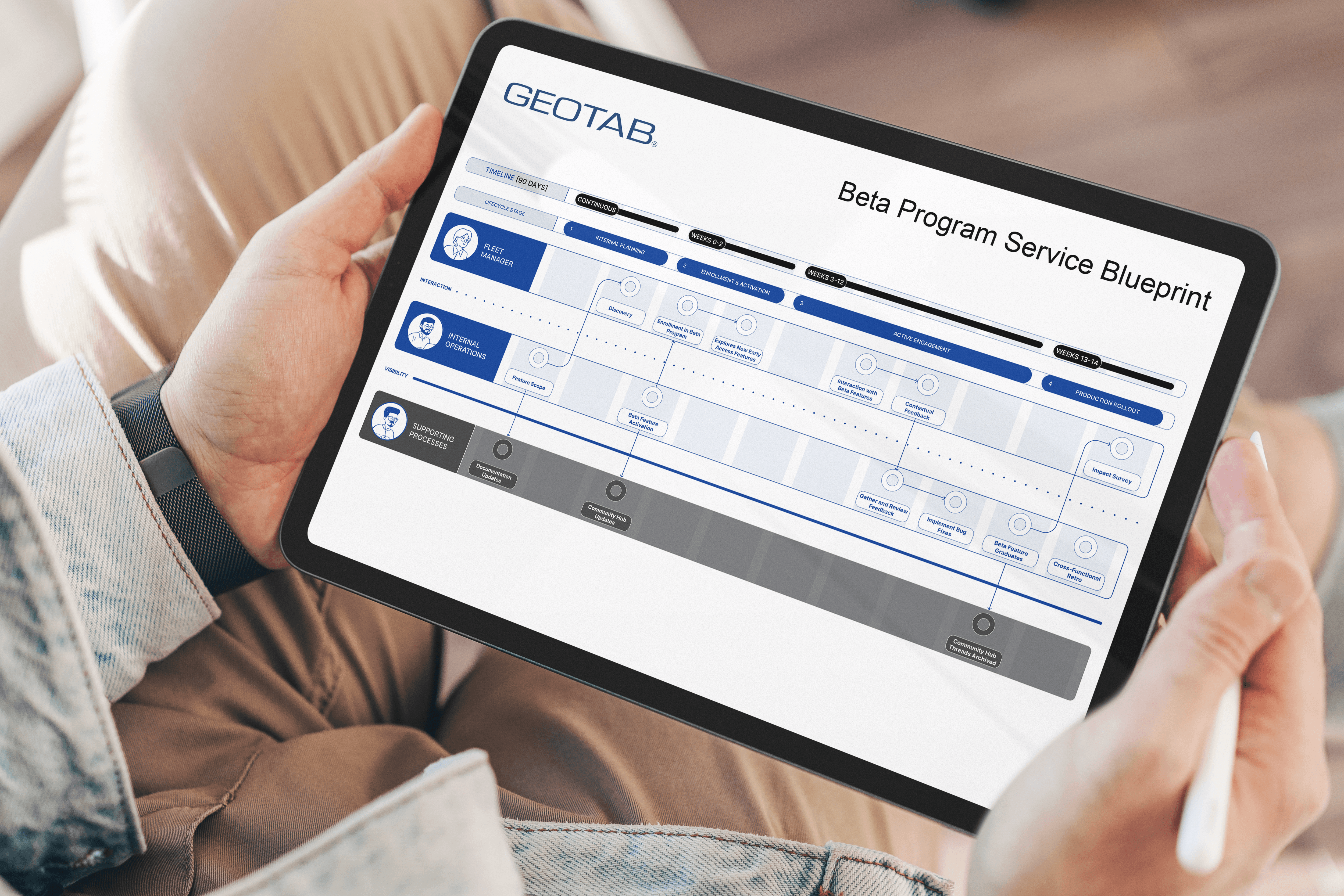
• Designing a service blueprint to align frontstage and backstage processes
• Defining clear graduation criteria and success signals
• Translating the blueprint into a reusable system that teams could adopt consistently
Service Blueprinting the Beta Lifecycle
I created a service blueprint that mapped the E2E beta lifecycle across multiple layers of the organization.
The blueprint visualized:
• Customer actions throughout the beta experience
• Frontstage activities across product, engineering, and support teams
• Backstage processes such as tooling, data collection, and internal reviews
• Lines of visibility and responsibility that clarified ownership at each stage
This created a shared artifact teams could use to discuss risk, readiness, and accountability.
Designing Graduation Criteria
One of the most critical outcomes of the blueprinting process was defining graduation criteria and clear thresholds that determined when a beta feature was ready to move forward.
These criteria were designed to balance:
• Product quality
• Technical stability
• Customer confidence
• Operational readiness
Rather than a single checklist, graduation criteria were grouped into categories such as:
• Feature completeness and stability
• User feedback quality and volume
• Support preparedness
• Operational and technical risk
This shifted graduation decisions from subjective judgment to explicit, shared standards, enabling teams to make informed tradeoffs with confidence.
Outcomes & Impact
This work resulted in a repeatable service model that could be applied across teams and product areas.
Key outcomes included:
• A standardized beta lifecycle with clear stages and expectations
• Improved cross-functional alignment around ownership and responsibilities
• More consistent and actionable customer feedback
• Clearer decision-making around feature readiness and risk
• A shared language for discussing beta success and graduation
The blueprint reframed beta programs from ad-hoc experiments into intentional, measurable services.
Learnings & Reflection
This project reinforced that service design is as much about decision clarity as it is about process.
By making invisible work visible (especially backstage dependencies and ownership) the service blueprint enabled teams to have better conversations and make better decisions.
It also highlighted the importance of designing systems that support variability. Instead of a rigid process, the goal was to create a framework flexible enough to support different teams while maintaining consistency where it mattered.
With more time, I would:
• Measure long-term adoption of the beta system across teams
• Explore tooling support to automate parts of the lifecycle
• Investigate how similar service patterns could support other internal programs